

We break down renting and buying in Dubai, bone by bone. Finances, laws, life hacks, and 3 key questions that will save you time and money.
Dubai is a city that attracts with career opportunities, the gleam of skyscrapers, and impeccable service. But as the initial excitement of moving fades, sooner or later everyone faces this question: pay rent “into thin air” or take the risk and invest in your own apartment? This isn’t just a day-to-day choice; it’s a decision that can shape your entire future life in the UAE, from financial stability to the feeling of having “a home of your own.” This article is your unbiased guide to the world of Dubai real estate. We won’t give you ready-made answers. Instead, we’ll provide a step-by-step comparative analysis, weigh all the pros and cons, examine the financial costs, legal intricacies, and investment potential of each option. Our goal is to give you a clear and understandable framework that will help you make a well-considered, informed decision perfectly tailored to your personal life scenario.
Renting vs. buying: A battle across key rounds
Instead of examining renting and buying separately, we’ll pit them directly against each other based on the criteria that matter most to you. Let’s see which option comes out on top in each round.
Round 1: Financial entry threshold
Renting: To rent an apartment in Dubai, you’ll need to prepare a sum that includes several components: a security deposit (typically 5–10% of the annual rental cost), an agent’s fee (usually 5%), the first rent payment (often for a quarter in advance), and administrative fees for registering the lease agreement in the Ejari system and connecting utilities (DEWA).
Buying: The path to homeownership begins with significantly larger investments. Be prepared for a down payment on a mortgage, which amounts to at least 20–25% of the property’s value. In addition, there is a 4% fee to the Dubai Land Department (DLD), registration fees, an agent’s commission (about 2%), and various bank fees for processing the mortgage.
Round conclusion: knockout in the first round. The entry threshold for renting is so much lower that buying simply doesn’t have time to strike back. For most expats at the outset, it is the only affordable option.
Round 2: Monthly and annual costs
Renting: The main and most predictable expense is the rent itself. In Dubai, it is customary to pay rent by check—either for one, two, four, or twelve months in advance. This is supplemented by monthly utility bills (water, electricity, air conditioning).
Insider tip on bargaining: The rental market in Dubai is a living entity. Don’t be afraid to negotiate! Requesting to split the annual payment into a larger number of checks (for example, 4 or even 12) is a standard practice that can significantly ease the burden on your budget.
Purchase: The primary monthly expense for a homeowner becomes the mortgage payment. However, that’s not all. Property owners are also required to pay annual building or community service charges, which cover expenses for maintaining pools, gyms, security, and cleaning. Plus, of course, utility bills.
Caution: service charges!: Before purchasing, request a detailed breakdown of service charges from the seller or the management company for the past couple of years. In some trendy skyscrapers, these fees can turn out to be an unpleasant surprise that eats up all the benefits of owning the property.
Round conclusion: a draw. Both “fighters” deliver significant blows to your wallet, but from different angles: renting through direct payments, and buying through mortgages and insidious service charges.
Visit any local bank’s website and experiment with the mortgage calculator. Compare the resulting monthly loan payment with the average rent for a similar property. Sometimes the difference turns out to be surprisingly small, which makes you think twice.
Round 3: Flexibility and freedom of action
Rental: This option offers maximum flexibility. At the end of your annual contract, you are free to change neighborhoods, choose a larger or smaller apartment, or even move to another country without incurring significant financial losses. The flip side is that you live within someone else’s walls: no major renovations or reconfigurations are allowed without the owner’s consent.
In Dubai, all rental agreements are registered in the Ejari system. This is not just a formality; it serves as your protection. The system makes the relationship between tenant and landlord transparent and regulated, preventing most disputes.
Buying: Owning property is synonymous with stability and rootedness. You gain complete freedom to turn the apartment into the home of your dreams, from repainting the walls to demolishing partitions. However, if you need to move urgently, the selling process can take months and may involve additional costs.
Round 4: Investment potential
Renting: From an investment perspective, renting is a financial “black hole.” You pay for the right to live here and now, but not a single dirham of that payment ever returns to you. Your money works to build your landlord’s wealth, not yours.
Buying: This directly creates an asset. Every mortgage payment is a building block in the foundation of your wealth. In addition, you benefit from the potential increase in property value on the market. Owning a property also opens up the opportunity to generate passive income through renting it out (ROI), turning your expenses into an investment.
Round 5: Visa status and long-term prospects
Rental: A lease agreement does not affect your visa status in any way. Your residency visa is typically tied to your employer, and its fate depends on your employment contract.
Purchase: Owning property provides a direct pathway to long-term residency. By purchasing a property above a certain value, you become eligible to apply for the Investor “Golden Visa.” This grants you and your family long-term stability and independence from your employer—a key factor for those who plan to tie their future to the UAE seriously and for the long term.
A map of opportunities: Where to drop anchor in Dubai?
Choosing the right district is 50% of success when it comes to solving your housing needs. Let’s look at the most popular locations so you can see which one resonates with your lifestyle.
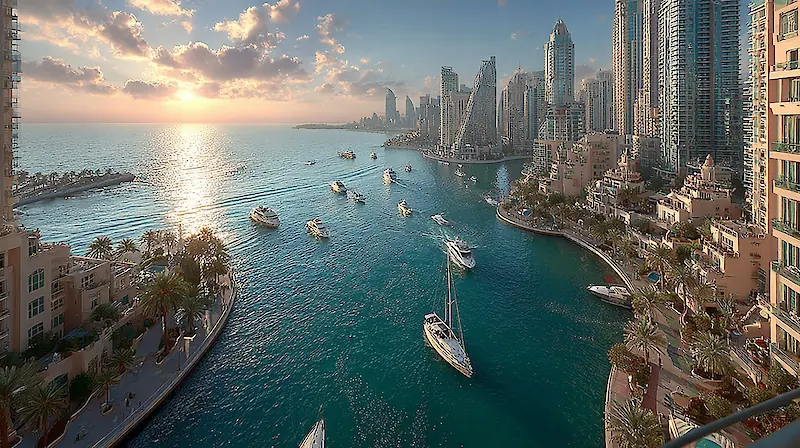
Dubai Marina & JBR: an eternal resort in the heart of the metropolis
- Types of housing: Modern apartments in breathtaking skyscrapers—from compact studios for singles to luxurious penthouses with panoramic views.
- Price level: High. You pay for the view, the infrastructure, and the lifestyle itself.
- Who it’s for: For the energetic and those who are passionate about urban living. For those who want to wake up to a view of a forest of masts and skyscrapers, have breakfast at a new café every day, and walk to the beach in just 10 minutes.
- What you’ll love: The feeling that you’re living in a never-ending celebration. A promenade for evening strolls, an endless selection of restaurants to suit every taste and budget, and that very “wow effect” when, at night, the city is reflected in the water of the canal.
- What you’ll have to come to terms with: Evening and weekend traffic jams, the constant struggle to find parking for guests, and the feeling of living “window to window” due to the high-density development.
Downtown & Business Bay: the pulse of the business world
- Types of housing: Elite apartments, often in branded residences from world-renowned hotel chains. Status is the key here.
- Price level: Sky-high. This is the price you pay for the most prestigious postal code in the city.
- Who it’s for: Ambitious career-driven individuals, entrepreneurs, and those for whom proximity to Burj Khalifa and Dubai Mall is not just a convenience but a part of their image.
- What you’ll love: The feeling that you’re at the very center of the universe. The ability to walk to the best restaurants, the opera house, and your office. A prestigious address that makes a lasting impression.
- What you’ll have to come to terms with: Very high prices for everything, a constant stream of tourists, and intense traffic that almost never lets up.
Dubai Hills & Arabian Ranches: an oasis for families
- Types of housing: Spacious villas, townhouses, and low-rise residential complexes nestled amidst lush greenery. Here, everything is designed for a comfortable family life.
- Price level: Ranges from moderately high to premium, depending on the size of the villa and the community.
- For whom: Families with children who value tranquility, safety, and space. Ideal for those willing to trade a view of skyscrapers for a view of their own lawn and golf courses.
- What you’ll love: The peace and security. Vast green parks where children can run freely, top international schools right nearby, and a genuine sense of community where neighbors know one another.
- What you’ll have to accept: The distance from the city center and the coastline. A personal car here is not a luxury but a necessity. An impromptu trip “into the city” requires careful planning.

From theory to practice: Your step-by-step action plan
Now that the key differences and neighborhoods have been explored, here are specific action plans for each approach.
Checklist for future tenants
- Budgeting: Compile a comprehensive list of expenses. In addition to the annual rent, factor in the security deposit, agent’s commission, as well as fees for registering the lease agreement with Ejari and connecting electricity and water (DEWA).
- Documents: Prepare the required package: copies of your Emirates ID and residency visa. You will also need a checkbook opened at a local bank—this is essential.
- Process: Find a certified real estate agent, arrange viewings of properties you like, carefully examine the lease agreement with a magnifying glass, and sign it before registering it in the Ejari system.
Roadmap for future property owners
- Budgeting: Calculate the total purchase budget. To the price of the property itself, be sure to add the DLD fee (4%), the agent’s commission, bank fees for processing the mortgage, and other administrative expenses.
- Documents: Gather the necessary documents for the bank (salary certificates, bank statements) to obtain a mortgage, as well as for the Land Department (DLD) to register the property.
- Transaction stages: The process involves several steps: obtaining pre-approval for a mortgage from the bank, signing a Memorandum of Understanding (MOU) with the seller, the bank’s final property valuation, obtaining a No Objection Certificate (NOC) from the developer, and finally transferring ownership at the DLD office.
- Assemble your “Dream Team”: Buying property in Dubai is not the time to skimp on professionals. A good RERA-certified broker and a meticulous lawyer are your insurance against hidden pitfalls, lost money, and sleepless nights. Their fees are an investment in your peace of mind.
RERA – your guardian angel: The Real Estate Regulatory Agency (RERA) is a government body that keeps the Dubai real estate market in check. Always verify that your agent is registered with RERA. This is your primary guarantee of the transaction’s legality, transparency, and security.
Final decision: 3 Key questions to ask yourself
We’ve covered all the aspects. To summarize briefly: renting offers operational flexibility and a low entry threshold, while buying provides a strategic asset and long-term stability. There is no “better” option—there is only the one that suits you best. To find it, answer three questions honestly.
Question 1: What is your time horizon in Dubai?
- Less than 3 years: Renting will almost always be more advantageous. The high transaction costs associated with buying and subsequently selling (DLD fees, commissions) simply won’t have enough time to be offset by potential property value appreciation over such a short period.
- 5+ years: Buying becomes a serious and financially sound option. Over this period, you can “ride out” potential market fluctuations, and your mortgage payments will begin to build substantial equity.
Question 2: What is your financial cushion?
Are you prepared for large one-time expenses such as a down payment and associated fees? Or do you prefer a lower entry threshold and predictable monthly expenses without “surprises” in the form of maintenance bills or urgent repair costs?
Question 3: What is your primary goal?
Do you want maximum freedom to “test out” the city, easily change jobs, or even move to another country without being tied to a property? (→ Rental)
Or are you aiming to create an “anchor,” put down roots, acquire an investment asset that will appreciate in value, and secure visa independence for yourself and your family? (→ Purchase)
For a moment, forget about market trends and “expert” advice. The right answer to the question “rent or buy?” doesn’t lie in DLD reports—it lies in your honest answers to these three questions. Because this isn’t just a real estate transaction; it’s a bet on your own future in this city.


















Comments