

From purchasing an NOL card to understanding the rules of conduct in futuristic driverless train cars—we’ve gathered everything a traveler needs to know for fast, affordable, and comfortable trips around the city of the future.

Futuristic driverless trains and stations that look like spaceships - Dubai’s metro truly is impressive. But behind all this beauty lies a system that can leave any newcomer baffled: seven fare zones, three types of NOL cards, strict rules, and not-so-small fines. How do you choose the right ticket? Why does the turnstile block you even though there’s money on your card? And how do you avoid getting fined for chewing gum? This guide answers all these questions and turns your journeys from an obstacle course into a fast, affordable, and comfortable way to explore the city of the future.
Your key to Dubai: Everything you need to know about the NOL card
Forget tokens and paper tickets. In Dubai, a single card, NOL, governs all public transport, from the metro to buses and trams. It’s your all-in-one travel pass and transport wallet. Without it, you simply can’t get on the metro, so the first thing a budget-conscious traveler does in Dubai is familiarize themselves with the NOL card.
What is an NOL card?: The NOL card is a rechargeable contactless smart card that serves as a single payment method for all public transport in Dubai. Essentially, it is your transport wallet.
Which NOL card should a tourist choose?
There are three main types of cards relevant for travelers. The choice depends on how often and with what level of comfort you plan to move around the city.
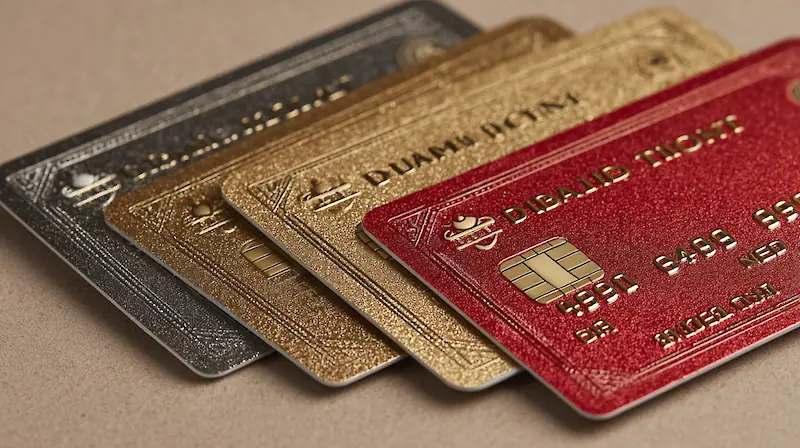
| Parameter | Red Ticket (Red Ticket) | Silver Card (Silver Card) | Gold Card (Gold Card) |
|---|---|---|---|
| For whom | Tourists for 1–2 trips | Ideal for most tourists | Connoisseurs of enhanced comfort |
| Issuance fee | 2 AED | 25 AED (with a balance of 19 AED) | 25 AED (with a balance of 19 AED) |
| Recharge | Yes (up to 10 trips) | Yes | Yes |
| Validity period | 90 days | 5 years | 5 years |
| Fare (1 / 2 / 3+ zones) | 4 / 6 / 8.5 AED | 3 / 5 / 7.5 AED | 6 / 10 / 15 AED |
| Our verdict | A single-use option. Useless if you're in the city for more than one day. | Your default choice. 99% of tourists need this one. | For those willing to pay twice as much for a leather seat and personal space. |
For the most up-to-date information on fares, we recommend visiting the official RTA website.
Where to buy and how to top up an NOL Card
Purchasing and topping up an NOL card is incredibly easy. Here are the main methods:
- Ticket machines at stations: The most popular method. They are located at every metro station and major bus stops. They accept both cash dirhams and bank cards.
- Ticket counters at stations: For those who prefer in-person assistance. Simply hand your card to the staff member and specify the amount you wish to top up.
- RTA Dubai mobile app: Allows you to register your card and top up its balance online using a bank card, Apple Pay, or Google Pay.
- RTA official website: The top-up process is similar to that in the mobile app.
- Partner outlets: Cards can be topped up at checkout counters in major supermarket chains, such as Carrefour.
The golden rule: Minimum balance on the card
This is the most important financial rule to remember to avoid an awkward situation at the turnstile.
Minimum balance for entry: To enter the metro, your NOL card must have at least 7.5 AED. If the balance is lower, the turnstile will simply not let you pass, even if the ride itself costs only 3 dirhams. This is a safeguard built into the system in case you travel long distances.
How to check your balance:
- On the turnstile screen each time you enter or exit.
- In ticket vending machines via the "Balance Check" option.
- In the RTA Dubai mobile app for registered cards.
Proven life hack: keep 15–20 AED on your card. This is your "non-burnable reserve," which saves you from the hassle of topping up before every trip and comes in handy if you suddenly decide to take a spontaneous ride across half the city.
How much does a ride cost: Understanding zones and fares
The cost of a trip depends not on the number of stations, but on the number of transport zones crossed (there are 7 in total). The entire territory of Dubai is divided into these zones, and the fare is calculated based on the number of zone boundaries you cross from the entry station to the exit station. The system also encourages transfers: if you transfer from the metro to a bus within 30 minutes, it will be counted as a single trip without additional charges.
Examples of fares for popular tourist routes
| Route | Start Zone | Finish Zone | Zones Crossed | Fare (Silver Card, AED) |
|---|---|---|---|---|
| DXB Airport → Burj Khalifa/Dubai Mall | Zone 5 | Zone 6 | 2 zones | 5.00 |
| Dubai Marina → Deira City Centre | Zone 2 | Zone 5 | 3+ zones | 7.50 |
| Ibn Battuta Mall → Mall of the Emirates | Zone 2 | Zone 2 | 1 zone | 3.00 |
For the most up-to-date fare information, we recommend visiting the official RTA website.
Your first Ttip: Step-by-step instructions
1. Route planning
To build an optimal route and calculate the exact cost of your trip, we strongly recommend using official tools: the RTA Dubai mobile app or the trip planner on rta.ae. These provide the most accurate and up-to-date information, unlike third-party navigation services.
2. Check-in and check-out: the key to correct payment
The main thing to remember about the payment system in the Dubai Metro is this: tap your card when you enter—and tap it again when you exit. This is an unbreakable rule. You must “check in” with your card twice: once when you enter the station and once when you leave. Only then can the system correctly calculate the cost of your journey.
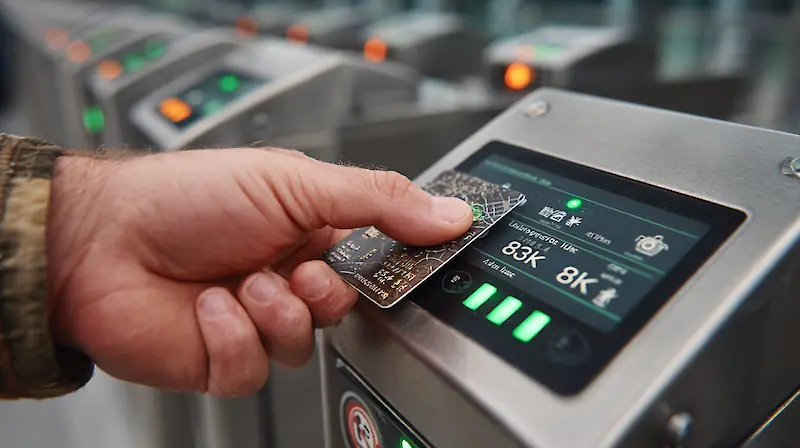
- Check-in (Entry): Tap your card against the validator. After the beep and a green indicator, the turnstile will open. The system has recorded the start of your journey.
- Check-out (Exit): At your destination station, tap the same card again against the validator at the exit. Only at this point will the system calculate the cost of your trip and deduct the appropriate amount.
What happens if you forget to tap your card on exit?: If you skip check-out, the system won’t know where you exited, and it will automatically charge you the maximum fare—7.5 AED (or 15 AED for a Gold Card)—even if you only traveled one station.
3. Navigation at stations
Getting lost at Dubai Metro stations is practically impossible, even if you’re visiting for the first time. Everything has been thought out down to the smallest detail: all signs are duplicated in English, each line has its own color (Red and Green), and the direction of travel is always indicated by the terminal station (for example, “towards Centrepoint” or “towards Expo 2020”). You just need to know the name of your station and the terminal station on your line.
Rules of the game: How to avoid fines in the Dubai metro
The impeccable cleanliness and order in the Dubai Metro are no accident—they are the result of very strict rules and unavoidable fines. To ensure that your trip doesn’t end with an unpleasant conversation with an inspector and a loss of 100–200 dirhams, remember a few simple “don’ts.”
Etiquette and key prohibitions
- Food and drinks: Strictly prohibited from the moment you pass through the turnstile. This includes chewing gum.
- Smoking: Prohibited throughout the entire metro area, including electronic cigarettes.
- Luggage: Passengers are allowed to carry up to two pieces of luggage per person, provided they do not obstruct others or block passageways.
- Noise: Phone conversations should be kept quiet, and listening to music or watching videos is permitted only with headphones.
Special carriages: don’t get them mixed up!
- Carriages for women and children: These sections are usually located at the front of the train and are marked on platforms and in carriages with special pink signs. Men are strictly prohibited from entering these carriages.
- Gold Class: These are higher-comfort carriages with more spacious leather seats. To travel in them, you must have a special NOL Gold Card.
What you can be fined for and how much
RTA inspectors regularly conduct inspections on trains and at stations.
Top 3 fines for tourists: Be especially careful! Most often, travelers receive fines for: 1) Eating or drinking in the carriage (100 AED), 2) A man traveling in the women's carriage (100 AED), 3) Attempting to ride in Gold Class with a regular card (200 AED).
| Violation | Fine Amount (AED) |
|---|---|
| Fare evasion / Non-payment of fare | 200 |
| Food, drinks, chewing gum | 100 |
| A man being in the women and children section | 100 |
| Sleeping in unauthorized areas (e.g., waiting areas) | 300 |
| Unjustified use of emergency equipment | 2,000 |
For the most up-to-date information on fines, we recommend visiting the official RTA website.
Yes, you heard right, sleeping on a bench while waiting for a train can indeed result in a fine. This rule is aimed at those who try to use air-conditioned stations as a place to spend the night. So if you're exhausted after a flight, it's better to hold out until you reach your hotel.
Key rules for confident travel: Your checklist
Dubai Metro is a fast, clean, safe, and affordable way to explore the city. Here's a quick cheat sheet for confident users:
- Your choice: Purchase a Silver NOL Card right away.
- Your balance: Always keep more than 7.5 AED on your card.
- Your ritual: Check-in upon entry and check-out upon exit—always!
- Your attentiveness: Pay attention to the pink and gold markings on the platforms.
- Your comfort: No food or drinks beyond the turnstiles.
- Your navigator: Use the official RTA Dubai app.
That’s it. Now the Dubai Metro is no longer a mysterious labyrinth for you—it’s a simple and straightforward tool that will save you a lot of money, time, and stress. Keep these simple rules in mind, and the futuristic trains will whisk you to any city attraction quickly and comfortably. Have a safe trip!





















Comments