
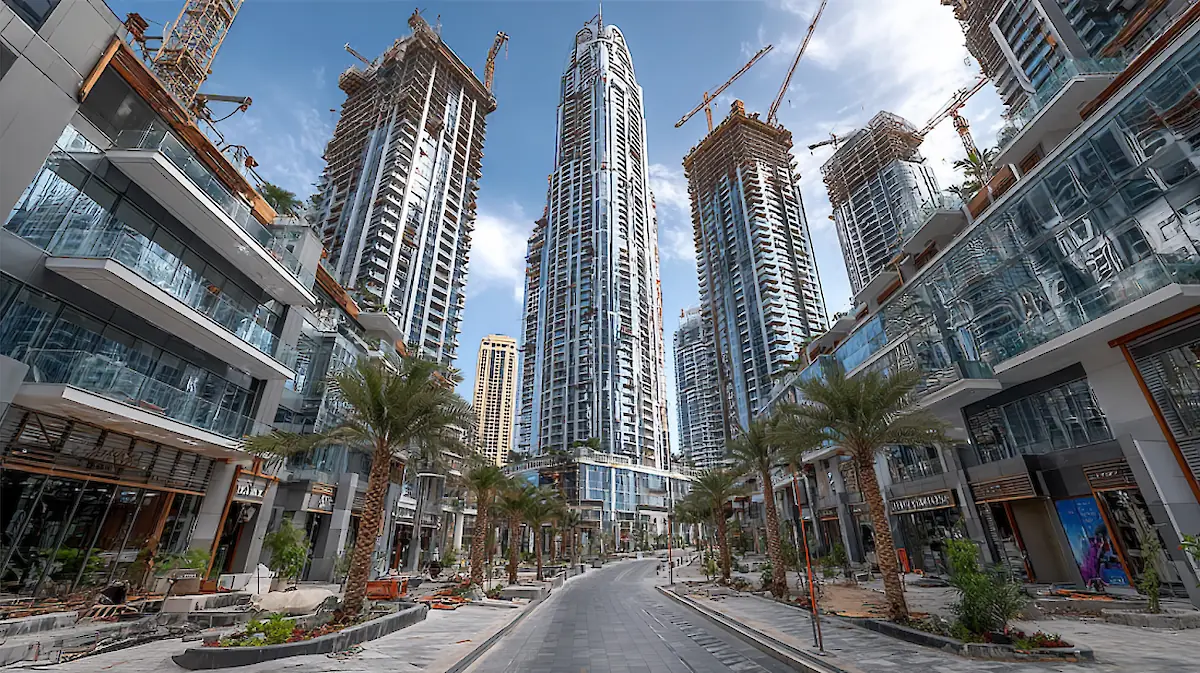
By 2026, Dubai’s off-plan market is no longer approaching the date as a vague milestone borrowed from developer presentations, but as a clearly defined time frame around which real decisions are already being made by both developers and investors. A large share of projects launched in 2023–2024 are scheduled for completion around this period, meaning the market is gradually shifting away from promises and into the phase of tangible supply. This matters. Investors are no longer buying an idea, but a nearly finished product whose future demand and liquidity can already be assessed with reasonable accuracy.
Unlike early off-plan stages, where growth exists largely “on paper,” projects with a 2026 completion horizon sit in the final phase of the construction cycle. Much of the surrounding infrastructure is either already in place or close to completion. That significantly reduces uncertainty, and uncertainty is the primary risk factor in any off-plan investment.
Why not all new developments are equally attractive for investment
A common mistake buyers make is treating the off-plan market as a single, uniform category. In reality, Dubai regularly delivers projects with fundamentally different investment profiles within the same calendar year. Some are designed from the outset for rental demand and broad market appeal. Others focus on lifestyle branding and owner-occupiers. A third group targets short-term resale strategies.
By 2026, the market’s shift toward more pragmatic formats becomes especially visible. Apartment layouts are becoming more compact, common areas more functional, and marketing is increasingly built around realistic usage scenarios rather than abstract ideas of a “dream lifestyle.” This is a direct response to tenant behavior. Demand is moving toward properties that are easy to rent, straightforward to manage, and liquid on resale — not simply attractive inside a showroom.
Location and project stage: What actually drives investment performance
By 2026, the difference between districts supported by steady, everyday demand and those driven primarily by novelty becomes far more pronounced. In the early years after launch, these areas can look similarly appealing: modern buildings, strong sales activity, and optimistic yield projections. Over time, however, the nature of demand reveals itself.
Central and semi-central locations tied to business activity, major transport corridors, and established urban infrastructure tend to show more stable rental performance. Demand here is not generated solely by new developments, but by a continuous inflow of residents, professionals, and companies. Price growth in such areas is usually more moderate, but downturns are also less severe. Even during periods of market cooling, properties in these locations tend to remain occupied.
Areas built primarily around new developments often experience faster growth at the beginning, but are far more sensitive to market cycles. While construction activity and buyer inflows remain strong, demand holds. Once the market becomes saturated, however, competition between similar units intensifies. For investors, this translates into higher volatility: potentially stronger returns during favorable periods, but greater exposure to vacancy risk and pricing pressure during downturns.
Project stage plays an equally important role. Developments approaching completion in 2026 have typically passed the most risk-intensive phases: key approvals, financing structures, and the bulk of construction work. This does not eliminate risk altogether, but it changes its nature. At this point, investors are no longer evaluating promises — they are evaluating visible progress, documented timelines, and measurable delivery.
Delays, operational changes, or management adjustments may still occur, but these tend to be localized and manageable rather than systemic. For many investors, late-stage projects therefore offer a more balanced proposition, combining reduced uncertainty with a more predictable investment outcome.
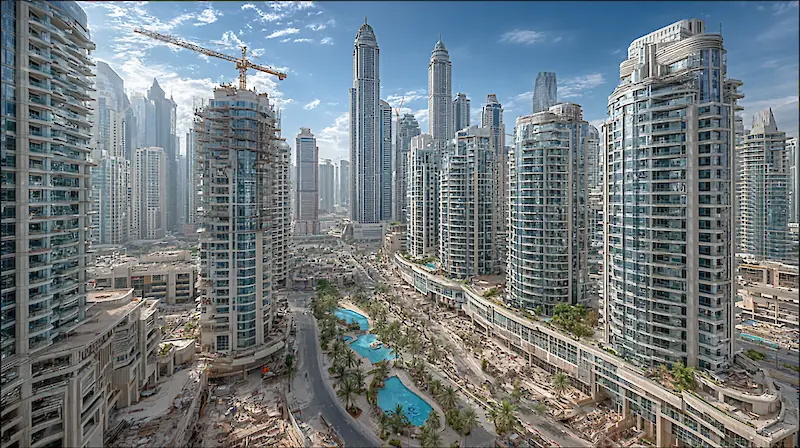
Developer and management: The factor that becomes critical after handover
By 2026, Dubai’s off-plan market increasingly separates developers into two distinct groups: those capable of bringing projects into a stable, functioning long-term state, and those focused primarily on selling units. At the moment of handover, this distinction is rarely obvious. Buildings look new, lobbies are polished, staff are present, and service processes appear to be in place. To the buyer, everything seems equally sound regardless of who delivered the project.
The differences emerge later. Two or three years after completion, it becomes clear whether the building was designed for long-term operation or merely for a strong initial impression. Decisions made during the design and construction phases begin to surface: the quality of engineering systems, the durability of materials, the logic of common areas, and the efficiency of ongoing maintenance. In Dubai’s climate, weaknesses are exposed quickly — cost-cutting in materials or technical solutions becomes visible far sooner than it would in more forgiving environments.
For investors, the financial implications are direct. Management quality affects not only tenant experience, but also the pace of physical deterioration, the frequency of unplanned repairs, and the level of service charges. Poorly managed buildings become increasingly expensive to operate, gradually eroding net returns and weakening resale appeal. Well-managed projects, by contrast, maintain their appearance longer, keep operating costs predictable, and remain attractive to both tenants and future buyers.
The advantage with projects completing around 2026 is that this factor can already be evaluated in advance. Investors can review earlier developments by the same developer: how they look several years after handover, what service charges owners actually pay, how often management companies are replaced, and how consistently building operations are maintained. This does not eliminate risk, but it significantly reduces the likelihood of unpleasant surprises.
Why 2026 is a convenient entry point
Many investors continue to search for the “perfect moment” to enter the market, delaying decisions while waiting for a correction, a cycle reversal, or more favorable conditions. In Dubai’s off-plan market, this approach often proves ineffective. The most rational entry points rarely coincide with price peaks or market bottoms. More often, they appear in the narrow window where a project is close to completion but not yet fully delivered.
That window is precisely where many 2026-completion projects now sit. The main construction risks are largely behind them, delivery timelines are more predictable, and the surrounding environment has taken shape. Investors can assess not only renders, but actual neighborhood development, transport connectivity, nearby projects, and real construction progress. This dramatically reduces the uncertainty typical of early off-plan stages.
At the same time, pricing often does not yet include the final “readiness premium.” As handover approaches — and especially after keys are delivered — the market typically prices in reduced risk and immediate usability. Entering before that stage allows investors to secure positions earlier without taking on the highest construction-phase risks.
As a result, 2026 represents a balanced entry point rather than a speculative bet. It is not an attempt to time the market, but a measured strategy where potential returns are paired with clearer visibility of the asset itself. For rental-focused, resale-oriented, or mixed-use strategies, this balance often proves optimal — particularly in a mature, highly competitive market like Dubai.
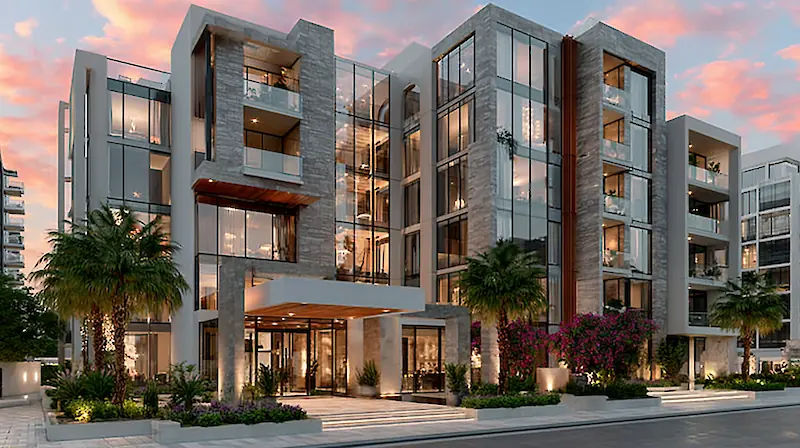
How to approach Dubai’s off-plan market in 2026
Projects scheduled for completion in 2026 are not about excitement or blind faith in continued growth. They are about calculation. About understanding the district, the project stage, the developer’s track record, and the long-term management model. In this segment, success favors those who evaluate property as a functioning asset with a defined use case, not those who choose the loudest render.
Approached soberly and without illusions, 2026 offers a rare opportunity to enter the market at a stage where almost everything is already visible — except what marketing brochures continue to embellish.












Comments