

We break down deposits, cancellation policies, and no-show penalties so that your dinner in Dubai leaves you with nothing but a pleasant aftertaste.
Dubai is a city where the gastronomic landscape evolves at a dizzying pace. With more than 26,000 restaurants, the emirate firmly holds second place worldwide in restaurant density, attracting top chefs and the most high-profile global concepts. However, behind the glitz of Michelin stars and panoramic views lies a complex booking system that can lead to unexpected financial losses for an unprepared traveler. High demand, especially in the premium segment, has given rise to its own culture: deposits, strict cancellation rules, and no-show penalties have become the norm here. These are not mere formalities—they represent real money that you can lose due to a single misstep. This guide is your bulletproof vest in the world of Dubai restaurant bookings. We’ll dissect all the rules of the game so you can confidently aim for the best tables, elegantly sidestep hidden fees, and focus solely on what matters most, the upcoming gastronomic pleasure.

The anatomy of booking in Dubai: How deposits, cancellations, and no-shows work
To avoid playing roulette with your money when booking a restaurant, you need to know three key rules. A deposit, cancellation policy, and no-show fee are not just fine print—they are real financial levers that establishments use to manage the endless flow of guests. Let’s take a look at how they work.
What is a deposit and why is it needed?
Simply put, a deposit is an advance payment that a restaurant takes as a guarantee of your visit. This amount is almost always deducted from your final bill. In Dubai, you’ll encounter three main types of deposits:
- Fixed amount: The most common option. You pay a specific sum for a table or per guest (usually between 200 and 1,000 dirhams) at the time of booking.
- Minimum spend: The restaurant sets a threshold below which your final bill cannot fall. Your card is used as a guarantee, and if you spend less, the difference up to the minimum amount will still be charged to your card.
- Card Hold (Card pre-authorization): The most traveler-friendly option. Your money stays with you—the restaurant doesn’t actually charge it but temporarily “freezes” the required amount on your card. Once you’ve dined, the hold is lifted.
Cancellation policy and no-show fees: key risks
The cancellation policy is a set of rules that determines how far in advance you can cancel your reservation without incurring any financial penalties. The standard “safe” period in Dubai is between 24 and 72 hours before the scheduled time. If you cancel later, the restaurant has the right to retain the full or partial deposit.
However, the most serious financial risk is a no-show, which means failing to show up without canceling the reservation. If you simply don’t arrive at the scheduled time, be prepared for the loss of 100% of your deposit or the deduction of the agreed-upon penalty.
Attention: no-show penalty!: If you don’t show up at the restaurant and fail to cancel your reservation on time, you are almost guaranteed to lose 100% of your deposit, or a penalty will be charged to your card. This is the main financial pitfall you need to keep in mind.
Where to book your dream table
Choosing how to make a reservation in Dubai is not just a matter of convenience—it’s a real strategy that affects price, reliability, and flexibility. Let’s look at three main options.
Directly through official websites and phone calls
This is the most reliable way to arrange a reservation directly with the restaurant, without intermediaries.
- Pros: Maximum reliability, as you receive confirmation firsthand. No intermediary fees and the ability to discuss special requests directly, such as a table by the window.
- Cons: Discounts and special offers are extremely rare here. A language barrier may arise when booking by phone.
- Who it suits: Those who are hunting for a table at the city’s most sought-after venue and are unwilling to take risks. Here, you pay for an ironclad guarantee.
Through online platforms and aggregators
This is the most popular and balanced option for most travelers. We’re talking about services such as TheFork, TripAdvisor, OpenTable, and others.
- Pros: The ability to compare conditions across different establishments, find exclusive discounts (sometimes up to 50%), read reviews from other diners, and use convenient search filters.
- Cons: An intermediary is introduced into the communication chain, which can sometimes complicate problem resolution.
- Who it suits: Most tourists who are looking for the best balance of price, quality, and convenience.
| Criterion | Restaurant’s official website | Aggregator (using TheFork/TripAdvisor as an example) |
|---|---|---|
| Price and Discounts | Base price; discounts are rare. | Often lower due to promotional offers (20–50%). |
| Cancellation Flexibility | Strict rules set by the restaurant itself (penalty for cancellations less than 24–48 hours in advance). | Often more flexible terms; the platform can act as an arbitrator in disputes. |
| Reliability | Maximum; direct confirmation. | High, but there is an intermediary involved. |
| Support | Direct contact with the restaurant. | Centralized and often multilingual support provided by the aggregator. |
VIP approach via concierge services
The most comfortable option is to hand over all the hassle to professionals—your hotel’s concierge or a travel agency.
- Pros: Maximum time savings. Concierges often have access to “exclusive” bookings and the best tables at restaurants where everything is fully booked online.
- Cons: The service is not always free. If you are not a guest at a luxury hotel, be prepared to pay the agency a fee simply for the act of booking.
- Who it suits: Guests of luxury hotels (for whom the concierge service is free) and those who value premium service and want to secure the most coveted spot at any cost.
Your action plan: From choosing the time to the visit
Now that we've covered the theory, let's move on to practice. This section is your step-by-step guide that will walk you through the entire online booking process, making it simple and secure.
Step by step: how to book a table online
Step 1: Selecting the date and time
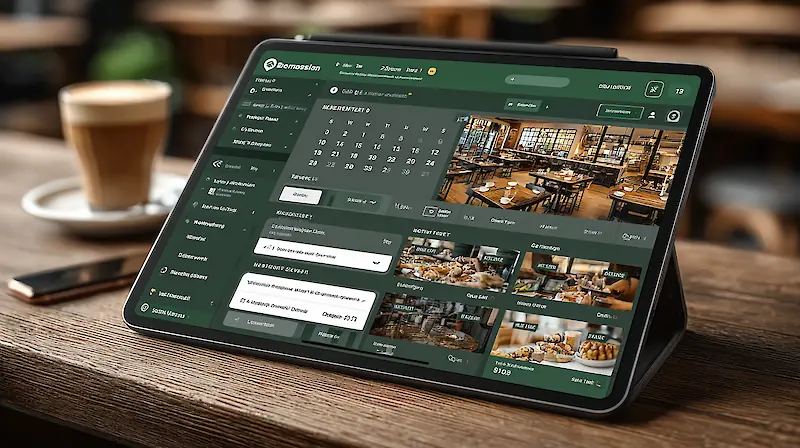
On the restaurant's website or aggregator, you'll see a simple form. Enter the number of guests, select your desired date in the calendar, and choose an available time slot. Typically, available options are highlighted for ease of use.
Step 2: Entering details and special requests
The system will ask you to enter your contact information: first and last name (preferably in Latin characters, as in your passport), email, and phone number. Pay attention to the field for special requests.
Little tip: the 'special requests' field: Use this field not only for allergies! Write here, 'Please confirm that the deposit will be deducted from the bill.' This is your additional proof in case of any misunderstandings.
Step 3: Final check
Now comes the moment of maximum concentration. This is your final checkpoint before clicking the "Pay" button. The system will display a summary page with all the information: the restaurant name, date, time, number of guests, your contact details, the total deposit amount, and the key cancellation terms. Carefully double-check every detail.
Financial aspects: payment, currency, and security
The primary method of paying the deposit is by bank card (Visa, Mastercard, American Express, UnionPay). Apple Pay and Google Pay are also accepted. There are several key nuances to keep in mind:
- Try to use a credit card rather than a debit card. Why? With a debit card, money is deducted immediately, whereas with a credit card you’re essentially spending the bank’s money. In the event of a dispute, the bank is much more willing to fight for its money (through the chargeback process) than you are for yours. For you, this provides an extra layer of protection and peace of mind.
Golden rule of saving: Always choose to pay in the local currency—dirhams (AED). Reject offers from the website to convert the amount into your home currency. This way you’ll avoid an unfavorable exchange rate and save up to 5–7%.
- Remember about taxes. All prices in the UAE, including deposits, are subject to value-added tax (VAT).
What you need to know about taxes in the UAE: Remember that VAT at 5% is added to all prices in restaurants and deposits. Make sure it is included in the total amount on the payment page.
After booking: confirmation and troubleshooting
Immediately after successful payment, you will receive a confirmation email. It will contain all key information, including your booking number. You do not need to print it, showing it on your smartphone screen upon entering the restaurant is sufficient.
If something goes wrong (for example, you don’t receive a confirmation), follow this procedure:
- Check your email (and spam folder) and your bank statement. Make sure the money has indeed been debited or blocked.
- Take a screenshot: Always save a screenshot of the final page with your booking number.
- Contact support: First, reach out to the customer support team of the platform through which you booked. If that doesn’t help, contact the restaurant directly.
- If nothing works: As a last resort in case of serious disputes, you can contact the Dubai Economy and Tourism (DET) department by phone at +971 600 555 559.
The bottom line: How to become a booking expert in Dubai
Booking a table in Dubai is not a minefield-it’s more like a game of chess where knowing the rules gives you a significant advantage. Now you know those rules. Any deposit, any cancellation policy for you is no longer a risk—it’s simply a clear and manageable step on the path to a magnificent dinner.
Pro tip: The ideal strategy: use aggregators like TheFork to find great deals and compare options, but always check the restaurant’s official website before making your final booking to double-check their cancellation policy. This way, you get the best of both worlds.
Traveler’s checklist:
Here’s a quick list of rules to help you always stay ahead:
- ✅ Always read the cancellation policy. Know the exact deadline by which you can cancel your reservation without incurring a penalty.
- ✅ Pay only in dirhams (AED). Refuse currency conversion on the website.
- ✅ Use a credit card instead of a debit card. This provides better protection for your funds.
- ✅ Take screenshots of your confirmation. This serves as your proof in case of disputes.
- ✅ Don’t be late! Being more than 15–20 minutes late without calling may result in your reservation being canceled and your deposit being forfeited.
Now you know everything you need to know. Dubai’s amazing gastronomic world awaits you, and you’re entering it not as a timid tourist but as a confident connoisseur. So forget your worries, open the restaurant map, and start planning what it’s all about, the perfect culinary adventure.






















Comments